
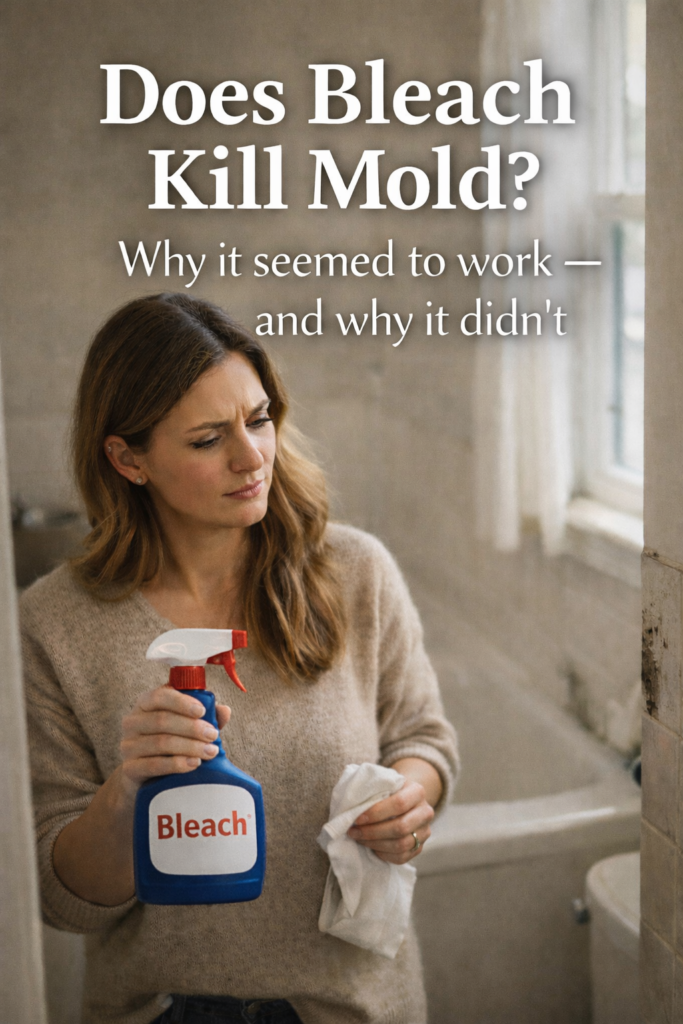
Does Bleach Kill Mold? Why It Seemed to Help at First — and Why That Belief Cost Me Time
I used bleach on mold because I thought that’s what responsible people did.
It looked clean. It smelled clean. And for a brief moment, I felt like I had handled it.
But that relief didn’t last — and what I didn’t understand at the time quietly delayed real answers. If you’re wondering whether bleach actually kills mold, you’re asking the right question.
Why bleach feels like the obvious answer
Bleach is what many of us associate with serious cleaning. It’s strong, familiar, and gives immediate visual feedback.
When mold appears — especially in bathrooms or kitchens — reaching for bleach feels like the responsible thing to do.
That’s exactly why I didn’t question it at first.
What bleach actually does — and what it doesn’t
Bleach can remove surface discoloration. That’s the part most people see.
What it doesn’t reliably do is address mold beneath the surface, especially on porous materials like drywall, grout, wood, or fabrics.
I didn’t understand that removing a stain isn’t the same as removing a living organism.
The mistake I didn’t realize I was repeating
Each time I used bleach, the mold seemed to disappear — until it came back.
And when it returned, it often felt more stubborn. Harder to ignore.
I later learned that adding moisture while disturbing mold can allow it to grow deeper into materials — even when the surface looks “clean.”
This pattern is something I explored more deeply when I realized why mold kept returning no matter how much I cleaned .
Why bleach can make exposure feel worse
Bleach fumes alone can irritate airways and the nervous system — especially for people already dealing with mold exposure.
I didn’t connect the dots at first. I thought feeling worse after cleaning was coincidence.
Over time, I noticed a pattern. The days I cleaned hardest were often the days I felt the worst.
That realization didn’t fully make sense until I understood how mold was affecting my brain, which I wrote about here .
What actually matters more than the product
The biggest shift for me wasn’t finding a stronger cleaner. It was understanding that mold is a moisture and containment problem first.
Without addressing moisture sources, airflow, and disturbance, no cleaning product can solve an ongoing mold issue.
That said, I did have to rethink how I cleaned.
For general, everyday household cleaning — the kind that isn’t focused on visible mold — I eventually moved away from harsh chemicals and toward gentler options that didn’t leave me feeling worse afterward. This is the type of all-around cleaner I now keep in rotation here , not because it “kills mold,” but because it cleans without adding another layer of stress.
When an area feels more concerning
There were also situations where an area didn’t just feel dirty — it felt suspect.
Spaces like bathroom grout, under sinks, or places that had stayed damp made me pause instead of reaching for bleach again.
In those cases, I learned to treat the area with more intention, using products specifically meant for mold treatment rather than surface whitening. This is the type of targeted treatment I reserve for higher-concern areas here , alongside ventilation and moisture correction — not as a shortcut.
So… does bleach kill mold?
In very limited, non-porous situations, bleach may reduce surface mold temporarily.
But in many real-world home situations, it creates a false sense of resolution.
I wish I had known sooner that “looking clean” isn’t the same as being safe.
The questions people ask after learning this
If bleach doesn’t work, did I make things worse?
Not necessarily. Many people use bleach without knowing better. What matters is recognizing when something isn’t resolving the issue.
Is there ever a time bleach is okay?
On truly non-porous surfaces, in limited situations, it may reduce surface growth. It just shouldn’t be relied on as a solution for ongoing mold problems.
Why does mold keep coming back even when I clean?
Mold thrives where moisture persists. Without addressing that root cause, cleaning alone rarely stops recurrence.
My bottom line
If bleach truly solved mold problems, fewer people would feel stuck in the same cycle.
What helped me wasn’t stronger chemicals — it was better understanding and gentler choices.
And if you want to understand how my thinking around mold and cleaning evolved, you can read more about my journey here.