
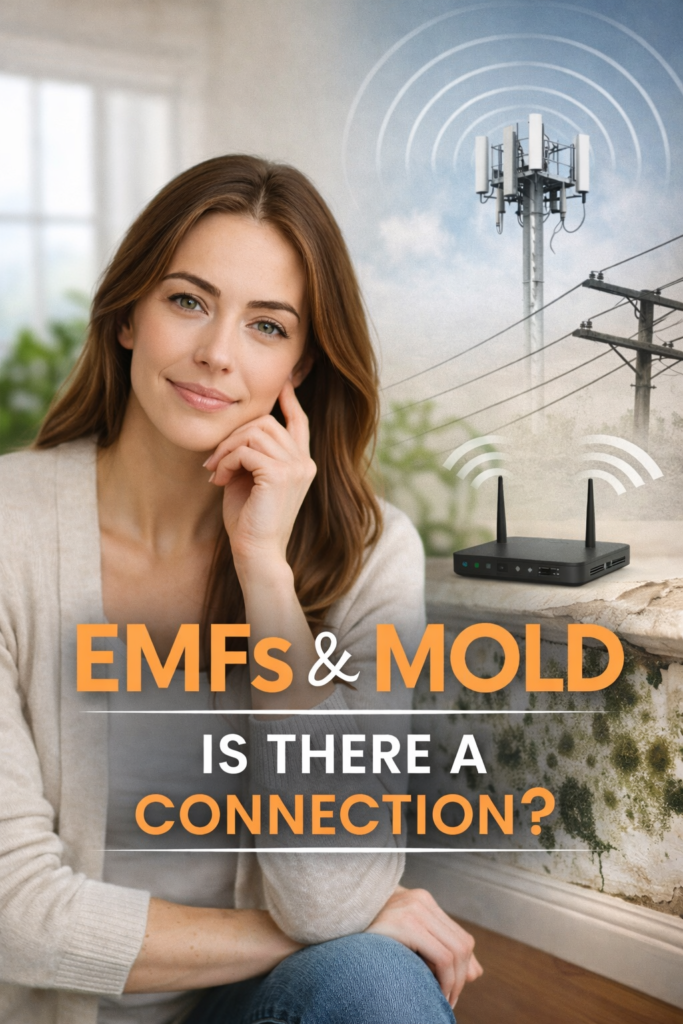
EMFs and Mold: What People Are Claiming, What the Science Actually Shows, and What Still Isn’t Clear
By Ava Hartwell
TL;DR: Mold growth in buildings is driven by moisture, not electromagnetic fields. Some laboratory studies suggest EMFs can influence microbial behavior under controlled conditions, but there is no strong real-world evidence that typical household EMF exposure makes indoor mold more toxic or more dangerous. The interaction question isn’t fully settled — but it’s also not proven.
Who This Article Is For
This article is for people who:
- Are living with or recovering from mold exposure
- Have heard claims linking EMFs to mold or mycotoxins
- Want careful, grounded explanations — not fear-based conclusions
- Are researching before changing their home or health decisions
I want to be very clear upfront: electromagnetic fields do not cause mold to grow. Mold requires moisture — leaks, humidity, condensation, or wet materials. Without water, mold cannot establish or expand.
The question I hear most often is more specific:
If mold is already present, could EMF exposure influence how that mold behaves — and could that matter for people living in the home?
I’m not fully convinced by the strongest claims online. But I also don’t believe the conversation should be dismissed outright.
Table of Contents
- The Claims You’ll See Online
- Why These Claims Exist
- What the Science Actually Shows
- What the Science Does Not Show
- Mold Biology vs Human Health Effects
- Where I Personally Land
- What Needs More Research
- Frequently Asked Questions
- The Bottom Line
The Claims You’ll See Online
Many online articles suggest EMFs from Wi-Fi, cell towers, power lines, or smart devices may:
- Accelerate mold growth
- Increase mycotoxin production
- Make mold more inflammatory or aggressive
- Worsen symptoms in people with mold illness
These claims often appear on wellness blogs, integrative medicine sites, and EMF-mitigation product pages. Some cite scientific papers; many rely on anecdotal experience.
Why These Claims Exist
Mold exposure often causes symptoms that feel neurological, inflammatory, and unpredictable. When symptoms fluctuate without clear triggers, people naturally look for additional environmental stressors.
EMFs are invisible, widespread, and poorly understood — which makes them an easy suspect.
There’s also a scientific basis for curiosity: microorganisms respond to environmental stress, and fungi can alter metabolism and secretion patterns.
What the Science Actually Shows
Laboratory studies show that electromagnetic fields can influence microbial behavior under controlled conditions.
Observed effects include:
- Changes in enzyme and protein secretion in fungi
- Altered intracellular signaling pathways
- Frequency-dependent changes in growth or sporulation
- Shifts in bacterial biofilm formation
Some studies involve fungi in the Aspergillus genus and bacteria such as Staphylococcus or Bacillus.
For readers who want to explore the primary literature:
What the Science Does Not Show
Current evidence does not show that normal household EMF exposure:
- Increases mold toxicity in buildings
- Meaningfully raises mycotoxin levels indoors
- Makes mold harder to remediate
- Overrides moisture as the primary driver
Most lab studies involve petri dishes, short exposure windows, and conditions that don’t reflect mold growing inside walls or dust.
Mold Biology vs Human Health Effects
This distinction matters.
Even if EMFs subtly influence microbial behavior, that does not automatically mean increased harm to humans.
Another hypothesis is that EMFs may affect the human nervous system or stress response, changing how symptoms are perceived — without changing the mold itself.
Major health organizations continue to evaluate EMF exposure:
- World Health Organization – EMF & health
- IARC – cancer risk classifications
- FCC – RF safety standards
Where I Personally Land
I’m not convinced EMFs are secretly making mold more dangerous in homes.
I’m also not convinced the topic is closed.
Environmental illness is rarely about one factor. Mold exposure is layered and individual. EMFs may influence symptom experience in some people — but that’s different from being the root cause.
What concerns me most is when EMFs become a distraction from moisture control, remediation, and clean air.
What Needs More Research
Responsible research would need to examine:
- Realistic indoor EMF exposure levels
- Mold growing on actual building materials
- Changes in toxin production, not just growth
- Health outcomes in mold-exposed populations
Frequently Asked Questions
Can Wi-Fi or 5G make mold grow faster?
There is no solid evidence that Wi-Fi or 5G accelerates mold growth in real homes. Moisture remains the controlling factor.
Can EMFs increase mycotoxin production?
Some lab studies explore microbial stress responses, but there is no strong evidence that household EMFs increase mycotoxin levels indoors.
Why do some people feel better after reducing EMF exposure?
Possible explanations include nervous system calming, placebo effects, or changes in other environmental variables — not necessarily mold behavior.
Should I focus on EMF mitigation if I have mold?
Priority should remain moisture control, remediation, and air quality. EMF mitigation may be a personal comfort choice, not a replacement strategy.
Is this topic settled?
No — but the strongest claims go far beyond the evidence we currently have.
The Bottom Line
Mold still needs water.
Buildings still fail because of moisture.
And remediation still succeeds or fails based on drying and removal.
Curiosity isn’t fear. Asking careful questions doesn’t mean accepting every claim.
IndoorAirInsight exists to help you think clearly — not fearfully — about the environment you live in.