
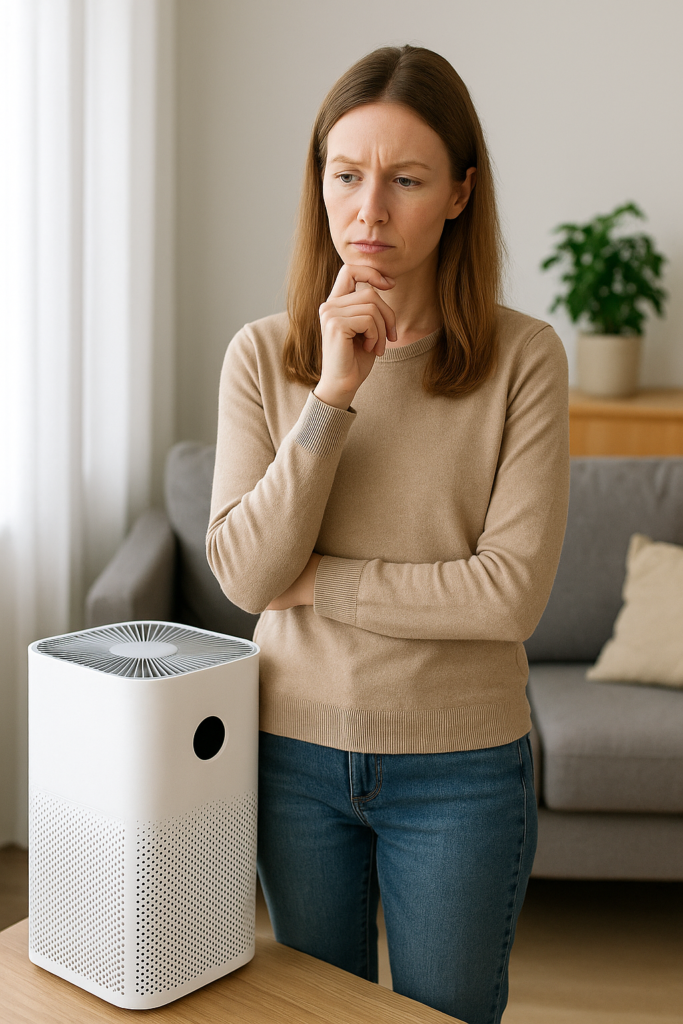
Why My First Air Purifier Didn’t Help (And What Finally Made a Real Difference)
By Ava Hartwell, IndoorAirInsights.com
I still remember unboxing my very first air purifier like it was some kind of rescue device.
I’d been sick for months, my nervous system was fried, and my once “dream home” had quietly become the
place that was hurting me. I was desperate and exhausted, so when the delivery truck dropped off that big
cardboard box, it felt like hope.
I plugged it in, turned it on high, and watched the little blue “clean air” light glow like a tiny miracle.
I honestly believed this one purchase was going to fix everything.
Spoiler: it didn’t.
When the “Magic Box” Doesn’t Fix a Sick House
Over the next few weeks, I kept the purifier running almost 24/7. It hummed, the filters slowly darkened,
and the indicator lights stayed reassuringly green. But my body didn’t get the memo.
- My brain fog was still brutal.
- I still woke up puffy and congested.
- My heart would race randomly for no reason.
- Walking into certain rooms made me instantly more tired and irritable.
I wanted to blame my body for being “too sensitive.” What I didn’t understand yet was that
you can’t purify your way out of an ongoing source of contamination.
An air purifier can help with particles floating in the air, but it can’t fix wet building materials,
active mold growth, or contaminated HVAC systems.
If you want the long version of how I got here and why I’m so stubborn about healthy buildings now,
you can read my full story here.
What Air Purifiers Actually Do (And What They Don’t)
Most decent portable air purifiers are built around three main ideas:
- Mechanical filtration – usually a HEPA or “HEPA-style” filter to capture particles.
- Gas/odor control – often activated carbon to help with smells and some chemicals.
- Air movement – a fan that pulls room air through the filters over and over again.
The U.S. Environmental Protection Agency confirms that portable air cleaners with true HEPA filters
can reduce airborne particles, including some allergens and smoke, when they’re sized correctly for the room and used continuously.EPA source
That’s the good news.
But here’s the part that often gets skipped in the marketing:
- They don’t remove particles stuck in carpets, bedding, or dust layers.
- They don’t fix water leaks, condensation problems, or wet drywall.
- They usually don’t touch the mold and dust hiding inside wall cavities, crawlspaces, or attics.
- They can’t solve a contaminated HVAC system that blows spores and fragments into every room.
For me, the purifier was trying to clean air in a house that was still actively making new contamination every day.
It’s like trying to mop the floor while a pipe is still leaking: you’re always behind.
The Turning Point: When I Stopped Treating Symptoms and Started Finding Sources
The moment things began to shift in my health was the moment I changed one simple question:
Instead of “How can I feel better in this house?” I started asking, “Why is this house making me sick in the first place?”
That shift led me to:
- Inspect the attic and crawlspace instead of just the visible rooms.
- Look behind baseboards and under sinks, not just at the surfaces.
- Pay attention to which rooms made my symptoms flare within minutes.
- Test my environment instead of guessing.
Eventually, we discovered extensive hidden moisture damage from construction errors. No amount of air
purifying could “neutralize” that. It had to be removed, remediated correctly, and then supported with better
filtration and ventilation.
If you’re curious about another common “shortcut” that didn’t work for me, I wrote an entire post about
the false comfort of houseplants as air cleaners:
The Air-Purifying Plant Myth: What Actually Helped After My Home Made Me Sick.
What Finally Helped (Yes, Air Purifiers Can Still Be Part of the Solution)
I don’t hate air purifiers. In fact, I still use them. I just use them very differently now, and only
after I’ve addressed the big root causes.
1. Identifying and fixing moisture problems
Mold is a moisture problem first. Once we found the water intrusion points and damaged materials,
getting those corrected and properly remediated was non-negotiable.
Without that, every other step is just damage control.
2. Cleaning the home like it had a job interview
I stopped doing “weekend cleaning” and started doing slow, methodical, top-down cleaning:
- Damp dusting instead of dry dusting (so particles don’t go airborne).
- HEPA vacuuming on floors, mattresses, upholstery, and vents.
- Washing textiles more often than felt normal at first.
It’s not about perfection; it’s about reducing the overall particle load so my body isn’t constantly fighting.
3. Using air purifiers as support, not the main solution
With the source issues under control, the purifiers finally started doing what I originally hoped:
taking the edge off.
Here’s what made a difference:
- True HEPA filters rated to capture very small particles.
- Enough airflow (CADR) for the actual room size, not the marketing claims.
- Running them continuously on low or medium instead of just when I “felt bad.”
- Putting them where I spent the most time – bedroom, home office, and living room.
Agencies like the EPA and CDC both recommend portable HEPA air cleaners as part of a
layered strategy for improving indoor air, especially for things like smoke events and
high particulate days – but they are very clear that source control and ventilation come first.CDC guidance
That lines up perfectly with my lived experience.
Questions to Ask Before Buying (Or Keeping) an Air Purifier
If I could go back and sit beside “old me” as she unboxed that first purifier, here’s what I’d ask her:
- What problem am I actually trying to solve? Odors? Dust? Mold? Smoke? All of the above?
- Have I checked for obvious moisture or mold sources? Under sinks, around windows, in the attic, in the crawlspace?
- Is this purifier really big enough for the space? (Look for CADR and square footage, not just marketing language.)
- Does this company clearly share filter specs? “HEPA-style” is not the same as certified HEPA.
- Am I expecting this machine to fix problems that actually require remediation?
If your honest answer is “I don’t know” to most of those, you’re not alone. I didn’t know either.
You’re learning faster than I did, and that already matters.
My Honest Takeaway (From Someone Who Tried to Outsmart a Sick House)
I wanted a shortcut. I wanted the magic, plug-in solution that would let me stay in my home the way it was.
I wanted to believe the “99.97% cleaner air” claims on the box more than I wanted to listen to my body.
What I eventually learned is this:
Air purifiers are tools, not saviors. They work best in homes that are already being cared for – not in homes that are quietly falling apart behind the walls.
If you’re sitting in a room right now with an air purifier humming and you’re still not feeling well,
I see you. You’re not crazy, and your body isn’t “too sensitive.” It might just be telling you to
look deeper than the box on the floor.
Your home should be the place that lets you heal, not the thing you have to recover from.
And sometimes the most loving thing you can do for yourself is to stop asking a machine to do a job
that only real investigation and real repairs can actually handle.
With you in this,
Ava