
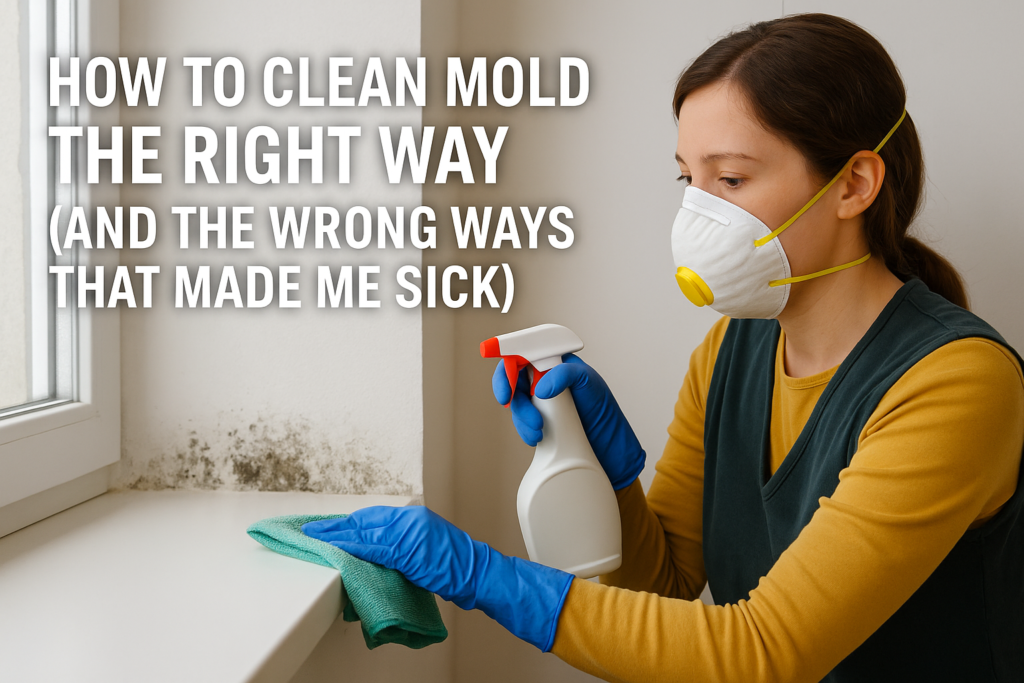
How to Clean Mold the Right Way (And the Wrong Ways That Made Me Sicker)
By Ava Hartwell
If you had told me years ago that one day I’d be able to walk into a room and tell immediately whether the air was “off,” I would’ve laughed. I wasn’t someone who knew anything about indoor air quality. I didn’t even own a decent vacuum. I was just a woman living in the home she built, wondering why her health kept unraveling one confusing symptom at a time.
Back then, cleaning mold felt like just another chore. You see a stain, you scrub it. Easy, right?
Except nothing about mold is “easy,” and I ended up learning that the worst way possible: by doing almost everything wrong before I understood what was actually happening inside my walls.
This is the article I wish I had stumbled across years earlier.
Before Anything Else: You Have to Fix the Moisture Problem
Nobody likes this part. Nobody wants this part. But it’s the truth: you can clean mold perfectly and it will still come back if water is finding a way in somewhere.
For months, I cleaned around one of our windows over and over again. Every few weeks that little gray spot reappeared like clockwork, almost as if the house was mocking me. It wasn’t until a much later inspection that I learned water was slipping in behind the siding the entire time. I wasn’t fighting mold at all — I was fighting the consequences of a construction mistake I didn’t know existed.
You can’t clean your way out of an ongoing moisture source — that’s why mold keeps coming back after you clean it. You have to find it and fix it on the mold and moisture side of the house, otherwise you’re basically decorating mold, not removing it. If the gray keeps returning near a window, I also wrote about signs of hidden moisture behind walls.
The Wrong Ways to Clean Mold (That I Personally Tried)
Here’s where it gets a little embarrassing. Every “common” mold-cleaning mistake? I’ve made it.
1. Spraying Bleach on Mold
Bleach gives you that satisfying “it disappeared!” feeling… and then the mold comes back angrier. Bleach only lightens the stain — I unpacked that under does bleach kill mold. It doesn’t remove mold that has grown into porous materials, and it can actually worsen the problem by adding moisture.
I wish I had known this before turning my laundry room into a bleach-scented sauna.
2. Scrubbing Like I Was Cleaning for a Home Inspection
If you scrub mold dry or aggressively, you send microscopic fragments into the air — exactly where you don’t want them.
One of my biggest symptom spikes came after a day of well-intentioned “deep cleaning.” I had no idea I was essentially distributing the problem around the house.
3. Foggers, “Mold Bombs,” or Anything That Promises Quick Magic
I can’t tell you how badly I wanted these to work. The idea that you can push a button, fog the place, and come back to a healthier home is incredibly alluring.
But fogging doesn’t remove mold or damaged materials. It just coats things. My house smelled cleaner, but I felt worse — which was the first time I realized smell and health are not the same thing.
4. Painting Over Mold
Yes, I’ve done it. Yes, I regret it. Paint isn’t a solution; it’s a cover-up. Mold keeps metabolizing underneath, and sooner or later it shows back through.
5. Cleaning With the HVAC Still Running
This is how a small area of concern turns into a much bigger one. Your HVAC will happily transport particles into rooms you never touched.
I learned that lesson exactly once.
The Right Way to Clean Mold (The Method That Finally Made Sense)
Here’s what I now know works — not just in theory, but in real, lived practice inside a home that once made me very sick.
Step 1: Contain the Space
You don’t need plastic walls or a full hazmat setup. Just turn off the HVAC, close nearby doors, and stop air from circulating. Airflow spreads particles. No airflow = more control.
Step 2: Wear Protection
I used to clean mold with zero protection. Not even a mask. Looking back, I want to give that version of myself a hug and a respirator.
At minimum, use:
- Gloves
- Eye protection
- An N95 or P100 mask
Your lungs will thank you later.
Step 3: Use Damp Cleaning (This Was the Game Changer)
This is the step almost nobody teaches, yet it makes the biggest difference. When things are damp, particles don’t fly. They stick.
My process now looks like this:
- Lightly mist the area with a cleaning solution.
- Let it sit for a few minutes.
- Wipe gently with a damp microfiber cloth.
Not scrubbing. Not scraping. Not “breaking it loose.” Just calm, controlled removal.
Step 4: Choose a Simple, Effective Cleaner
Despite what the cleaning aisle wants you to believe, you don’t need 47 different mold sprays. On non-porous surfaces, simple soap and water or a mild detergent is usually enough.
On porous materials, cleaning is rarely enough. Things like drywall, insulation, and particleboard often have to be removed because mold grows inside them — not just on the surface.
The U.S. Environmental Protection Agency gives straightforward guidance on homeowner mold cleanup here: EPA Mold Cleanup Guidance .
Step 5: Finish With a HEPA Vacuum
Not your regular vacuum — a true sealed HEPA vacuum. I trust HEPA vacuums with sealed systems for this step because they catch the particles you didn’t see or wipe. A purifier is support only — I wrote what air purifiers can and can’t do for mold separately.
Step 6: Know What Shouldn’t Be Cleaned At All
This is the heartbreaking part.
Things like:
- Drywall
- Carpet
- Insulation
- Cardboard
- Particleboard
…can’t be truly cleaned once mold is inside them. It took removing materials from my own home for me to understand that “cleanable” and “saveable” are not the same thing.
What About Natural Cleaners?
People always ask about vinegar, peroxide, tea tree oil… all the “green” options. A quick reality check:
- Vinegar works on some surfaces but isn’t a universal mold killer.
- Peroxide can help on hard surfaces but can damage certain finishes.
- Essential oils make the room smell lovely and fix absolutely nothing about structural mold.
They’re tools — not complete solutions.
When You Shouldn’t Clean Mold Yourself
There are times when DIY is not your friend. That’s when I point people to the cleaning and remediation door (and, when the job is bigger than a cloth, how to hire a mold remediation contractor you can trust). Call a professional if:
- The area is bigger than a few square feet.
- You feel worse in the area or when you disturb it.
- Moisture keeps returning, even after “repairs.”
- The mold is in your HVAC system or ductwork.
- You’re dealing with contaminated or “dirty” water (like sewage).
The CDC has a simple overview that’s helpful for homeowners: CDC Mold FAQ.
My Honest Reflection
When I look back on everything I did wrong, I don’t feel embarrassed anymore — I feel grateful. Every mistake taught me something that eventually helped me heal. And now I get to hand those lessons to people who are standing exactly where I once stood: confused, tired, overwhelmed, and desperate for clarity.
Mold isn’t just a stain. It’s not dirt. And it’s definitely not a cleaning job you can muscle your way through. The right approach is calm, methodical, gentle, and informed.
If you’re learning this later than you wish you had, you’re in good company. I didn’t get here gracefully either.
With you in this,
Ava
If you’re new here, Start Here is the map of this site. You can also read more about how my own journey through mold exposure and environmental illness began on my About page here.
Thank you! Im struggling with trying to heal and clean my home for my family. This helps so much. GOD BLESS
Pingback: Is It Mold or Just Dust? How I Learned to Tell the Difference Before It Got Worse - IndoorAirInsight.com
Pingback: How to Hire a Mold Remediation Contractor You Can Actually Trust (And the Questions You Must Ask First) - IndoorAirInsight.com
Pingback: Hidden Mold Symptoms Most Doctors Don’t Connect to Your Home - IndoorAirInsight.com
Pingback: Why Mold Makes You Feel Worse at Home (And Better the Moment You Leave) - IndoorAirInsight.com
Pingback: Force of Nature Multi-Purpose Cleaner, Disinfectant & Deodorizer — My Honest Review - IndoorAirInsight.com
Pingback: The Bathroom Fan We Shut Off Too Soon - IndoorAirInsight.com