
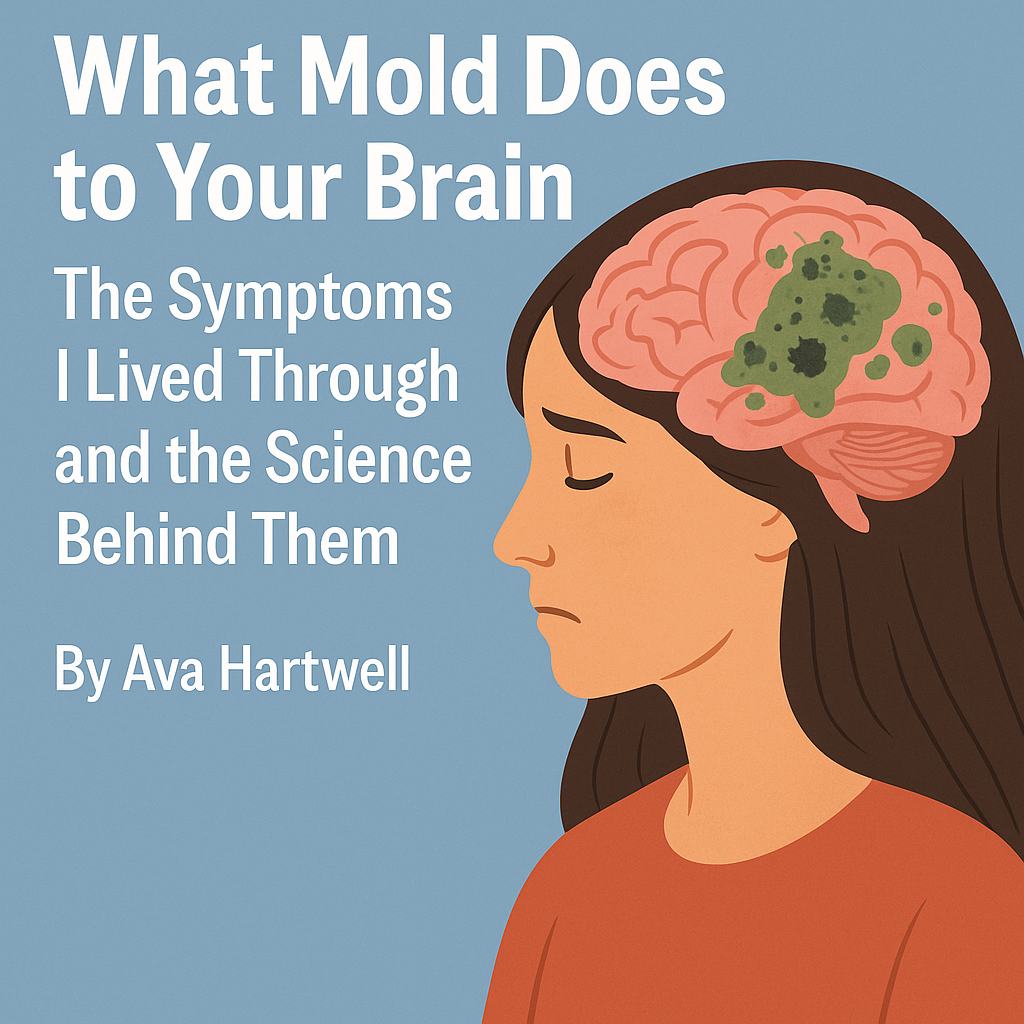
What Mold Does to Your Brain: Symptoms I Lived Through and the Proof
I lost a word in the kitchen while the closed bedroom kept its weather down the hall. Not a rare word. A ordinary one. I stood with a cabinet open and a child’s lunch half-built and the sentence in my mouth simply ended. I laughed because the alternative was to be frightened in a house that still photographed like a decision I was proud of.
The title of this page uses the word proof. I should say the honest thing before I tell you about the driveway. I do not have proof. I have a record: a sill that would not wipe like dust, a leak I had called finished, air that thickened in one room, and a mind that went thin in the same weeks. That is not a study. That is not a diagnosis. If thinking changes in a way that scares you or lasts, that belongs with a clinician. I am the woman who reread the same line on a school form and blamed sleep.
The line I could not get through
Paperwork became a cliff. I would start a sentence on a permission slip and find I was still on the first clause. I reread. The words stayed words. They would not stack. I used to write lists without looking at my hand. In that house I wrote the same item twice and then could not remember whether I had meant milk or the other thing that lives next to milk.
It was worse after a stretch in the closed bedroom, worse after the HVAC had been running, worse on mornings when the sweet-stale smell was already in the hallway. It eased in the car. I have that pattern in my body and in theirs, the one I keep under feeling worse at home and better when we left. Fog that lifts two miles from a baseboard is a fact I lived. It is still not a lab result with my name on it.
I called it motherhood. I called it stress, which is what I was being called. The windowsill did not care what I called it. The gray came back in the same stripe.
The errand that forgot me
I drove to a place I drive all the time and sat in the lot without the reason. Keys in my lap. Storefront I recognized. The list I had made on the counter was still on the counter. For a few seconds the day had no handle. Then it came back in a clumsy pile: bread, the thing for school, the bill I had already paid in my head twice.
I was not drunk. I had slept, badly, in a room I had started shutting because the air felt thicker than the living room. I did not pull over and take a photograph of my brain. I bought what I could remember and went home to a hallway that smelled like cardboard that had been wet.
That is the kind of “proof” I actually hold. A parking lot. A smell. A child who needed a morning I could not assemble. If you are looking for a scan, this is the wrong page. If you are looking for a mother who got lost between her house and a familiar door, I was her.
What I tried to use as evidence instead of the room
I bought numbers. An air cassette on a polite afternoon. Later, an envelope I wanted to be a confession. Neither one wrote the word fog. I already told the first disappointment in the test that didn’t settle it. The testing door is there because I understand the wish. A tidy range does not reread a form for you. A shaded column does not sit in a parking lot.
I tried to hang the fog on a species the way people hang a coat. The types I found in this home still matter as wet places with names. They do not get to author a missing word. Matching was a dead end. The leak was not.
The building work lives under mold and moisture: a quiet stain, a cavity that had stayed damp, a sill that was a climate. I walked those with more courage after I stopped demanding that my mind produce a certificate.
The family I was failing to keep in focus
Fog made me short. I heard myself answer a small question like it was an accusation. Then I would lose the thread of the answer. The children were changing in that hallway too — sleep, mornings, the version of them that showed up in the car. I wrote what I saw, not a theory of their futures, under what I noticed in my kids in that house. Their clinicians are their clinicians. My lost words are mine.
I collected the quieter pieces of those months under health and exposure and under signs I did not connect to the home because they were easy to file as personality while the paint still looked fine. Irritability. Shallow sleep. A sense that I was performing a life I could not quite inhabit. None of that is a map of a brain region. I will not draw one. How I write here is on the editorial standards page so a title with the word brain cannot drag a mechanism through this kitchen.
Cognitive change that worries you is a reason to see a clinician. Damp drywall is a reason to look at water. I needed both rooms. I kept trying to make the wall do the doctor’s job and the doctor do the wall’s job. That delay had a cost in this hallway.
What I can stand behind, and what I cannot
I can stand behind this: in a house with a closed bedroom, a cool baseboard, and growth that finally showed when the wall opened, my thinking got sloppy in ways I could feel. I can stand behind the parking lot and the permission slip and the word that left. I cannot stand behind the word proof as if I ran a trial. I cannot stand behind a sentence that says what mold does to a brain as a rule for yours.
The CDC treats indoor dampness and mold as a reason to deal with the building. That is the public-health line I will put next to my lost errand. Fix the wet place. Take the mind to someone qualified when the mind scares you. Do not let a headline finish either sentence.
I still notice when a room wants the door shut. I still trust a morning that comes back in the car more than I trust a page that arrived with a bill. I still follow water before I follow a theory of thought. If you need the rest of the house after the title, Start Here is the map. The proof I have is a sill, a leak, and a woman who forgot why she had driven somewhere she knew. That was enough to keep looking. It was never enough to call it settled science. I live with that, on purpose.
Pingback: Hidden Mold Symptoms Most Doctors Don’t Connect to Your Home - IndoorAirInsight.com