
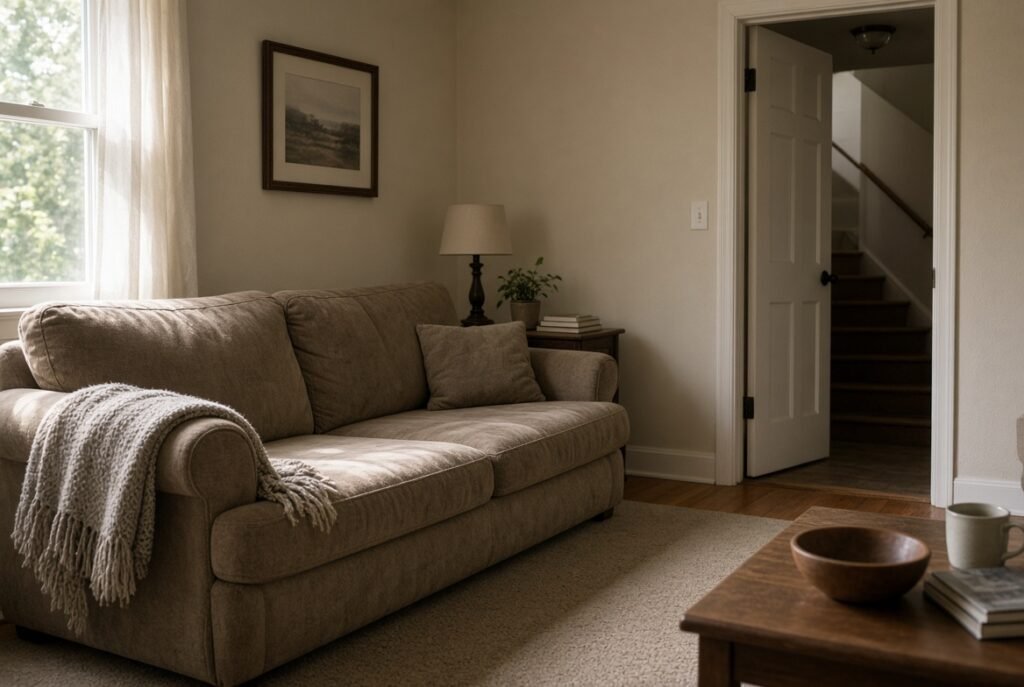
I sat down hard and the basement came up with me. Not a full smell. Just a note, cool and heavy, that rose from the cushions and settled across the living room. The throw blanket on the arm had started carrying it too. I had washed that blanket twice. It still smelled like the stairs.
The couch had looked fine the day we brought it up. We had needed the space. The living room felt small with the old chairs and the coffee table that never quite fit, so we rearranged and decided the basement couch could come upstairs. It had been under a sheet for a couple of years, near the plastic bins and the Christmas lights. A few wet springs had passed. The dehumidifier ran when we remembered. We told ourselves it was dry enough.
Carrying it upstairs
The two of us wrestled it up the stairs on a Saturday. The legs scraped. One cushion slipped and we caught it on the landing. By the time we set it down against the wall, we were both sweating and the living room already smelled different, though I did not name it yet. We vacuumed the floor where the old rug had been. We opened the windows. The couch sat there looking ordinary, a little sun-faded on one side, the fabric still soft where hands had rested.
For a few days it was fine. Then I noticed the cushions stayed cool even after the heat kicked on. When I sat back, the weight of them felt wrong, denser than they should have been. Nights I fell asleep there I woke with a thicker head. I blamed the late hour or the way I had my neck. I aired the room. I sprayed the fabric with the cleaner we kept under the sink. I flipped the cushions and put the whole thing closer to the window so the afternoon sun could reach it. The note did not leave. It just moved around the room and came back when the air settled.
I kept thinking about the basement and how the humidity climbed after rain, the way the air down there turned heavy even when the floor looked dry. I had read enough on the mold and moisture side of the house to know damp does not always announce itself on surfaces. It can sit in the air and then in whatever is left in that air long enough. The couch had been left there. So had the sheet that covered it. So had the bins beside it.
The foam under the cover
One afternoon I unzipped a cushion cover because the fabric still felt off and I wanted to see if the insert was the problem. The foam was a pale yellow-gray. It did not look damaged. I pressed my face to it the way you do when you are trying to decide if something is worth keeping. The smell was clearer then. Not strong. Just present, the same cool note that rose when I sat down hard. It had soaked into the foam and stayed. All the airing and vacuuming and sun had only moved the surface around. The inside still held what the basement had given it.
I sat on the floor with the cover in my lap and tried to sort what I was feeling. Part of me wanted to wash the cover again, buy new foam, spray the frame. Part of me already knew that would not be enough. We had not moved a couch upstairs. We had moved years of damp air that had nowhere else to go. The fabric and the foam had done what they do. They had held onto it. The living room was only telling me what had already happened downstairs.
That was the same lesson I had already learned with the carpet we kept steam cleaning and the way moisture kept returning even after the surface looked better. Cleaning the visible part does not always reach what has settled deeper. I had also watched how a closed room can hold onto whatever is in it, the way we had with the guest room we kept closed until the air inside it changed the rest of the house. Belongings can do the same thing. They can carry a space with them.
What I do before anything comes up
Now, before anything comes up from the basement or the garage, I take it into a closed room first. I shut the door. I leave it there for a day or two and then I open the door and smell the air before I smell the thing itself. If the room has picked up a note, the object stays down. I look at the underside and the frame or the back, wherever air could have sat against it. I check for damp or for the soft places that mean something has already started to break down. Sometimes the object looks perfectly fine and I still let it go. The living room is not the place I want to find out later that it was not fine.
I do the same with boxes and bags that have sat near the foundation. I remember how the humidity in the basement spikes after rain and what that air does to whatever is left in it. I have read the piece on why basement humidity spikes after rain enough times that the pattern is clear in my head even when I am only moving one cushion. The garage taught me a related lesson. We had treated it like outside for a long time, and then we had to learn what that meant for the things we stored there. The same rule applies when those things come inside.
When something does need cleaning, I go back to the basics on the cleaning and remediation side of the site instead of inventing a new routine in the moment. I still get confused about what is dust and what has been living in damp longer. The piece on how I learned to tell the difference helps me slow down and look again instead of deciding by smell alone. And when cleaning does not hold, I remember why mold can keep coming back even after the surface looks better. The air and the materials keep trading moisture. Belongings are part of that trade.
If you are still sorting how the rooms in your own house talk to each other, the start here page is the simplest place to begin. It does not promise a single fix. It just lays out the rooms and the habits that keep showing up. The couch is gone now. We carried it back down and then out. The living room took a few days to stop smelling like the stairs. I still catch myself pausing before I sit on anything that has lived somewhere damp. The cushions are just fabric and foam until they are not. Then they are the room they came from, sitting in the middle of the room you live in.