
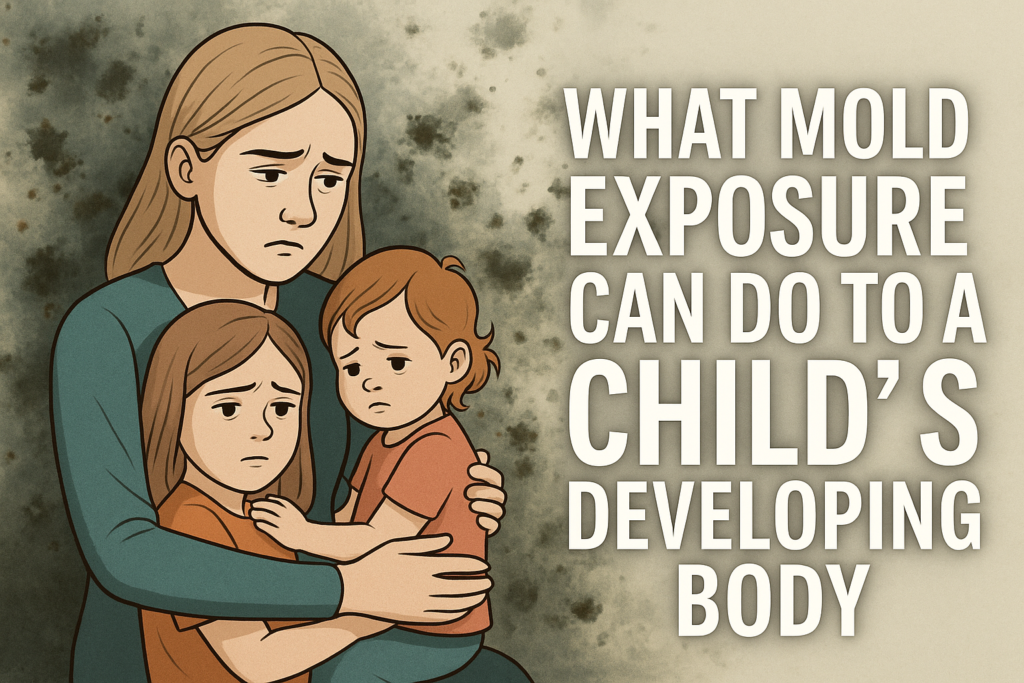
What Mold Exposure Can Do to a Child’s Developing Body (And Why So Many Parents Miss the Signs)
By Ava Hartwell
I can handle a lot when it comes to my own health. I’ve lived through brain fog so thick I forgot what I was saying mid-sentence, fatigue that made standing up feel like a workout, and anxiety that came out of nowhere. None of that compares to the moment I realized my two daughters had been breathing the same toxic indoor air that was making me sick.
At the time, my girls were just two and seven years old. One still in that soft, chubby toddler stage, the other just starting to read, ask big questions, and step into her own little personality. They trusted me to keep them safe. And I was tucking them in every night… in a house that was quietly hurting all of us.
I didn’t know our home was contaminated with mold. I didn’t know the walls were hiding a problem. I just knew that something felt wrong, and my kids were “off” in ways I couldn’t quite explain.
Why Kids React So Strongly to Mold
I learned the science later, after all the chaos. Kids aren’t just small adults. They breathe more air for their body weight, spend more time close to the floor where dust and particles settle, and their nervous, immune, and hormonal systems are still wiring themselves for the rest of their lives.
When the environment is wrong, their bodies feel it first — even if we, as parents, don’t put the pieces together right away.
Looking back, I can see it so clearly in my girls:
- my seven-year-old’s sudden mood swings and outbursts
- my two-year-old’s restless sleep and constant congestion
- the way they both seemed more fragile and overwhelmed than kids their age “should” be
At the time, I blamed myself. I thought I was failing as a mom. I didn’t realize the house I had built to give them a beautiful childhood was quietly undermining their health.
How Mold Showed Up in My Seven-Year-Old
My older daughter was always bright and curious. She’d devour books, ask questions nonstop, and pick up new skills quickly. Then, gradually, things changed.
She became:
- more irritable and weepy over tiny things
- overwhelmed by simple tasks that never used to bother her
- “foggy” when trying to focus on schoolwork or reading
- tired but wired — exhausted and yet unable to settle
Some days, it felt like I was watching her personality glitch. Teachers would say she seemed distracted or emotional. I wondered if it was just a “phase,” or if I was doing something wrong as a parent.
What I couldn’t see at the time was that her developing brain was trying to function in an environment that was constantly triggering inflammation and stress.
How Mold Showed Up in My Two-Year-Old
Toddlers are supposed to be energetic, unpredictable, and loud. That part, we had. But we also had:
- chronic congestion that never really went away
- restless sleep and frequent night waking
- random rashes and skin irritation
- clinginess and meltdowns that felt “bigger” than normal toddler storms
I remember rocking her at 2 a.m., her little body sweaty and unsettled, thinking, “Why can’t I get my baby comfortable? What am I missing?”
I washed sheets. Swapped detergents. Changed her diet. Tried to control every variable I could reach — except the one I couldn’t see: the mold hiding in our home.
The Most Telling Clue: They Felt Better Away from Home
The thing that finally started to crack the case wasn’t a test or a doctor. It was patterns.
I noticed my seven-year-old’s behavior and focus were better after weekends away. My two-year-old slept more peacefully when we stayed at a relative’s house.
The longer we were away from our home, the more they both seemed like themselves again:
- less emotional volatility
- fewer coughing fits
- easier bedtimes
- more laughter, less tension
Coming back home felt like walking back into an invisible storm. They didn’t have the words for it, but their bodies were telling the truth before any lab did.
What Mold Can Do to a Developing Child
I want to be careful here — my goal isn’t to scare you, but to validate what you may already be sensing. Mold exposure in kids can show up in quiet, sneaky ways:
- trouble focusing, learning, or remembering things
- heightened anxiety or emotional reactivity
- frequent “colds” that never fully resolve
- asthma-like symptoms, coughing, or wheezing
- headaches, stomachaches, or “I just don’t feel good” complaints
When this goes on for months or years, it doesn’t just make childhood harder — it can shape how their nervous system and immune system develop. That was the part that broke me when I finally understood it: the idea that my daughters’ bodies had been trying to grow and thrive inside an environment that was constantly pushing against them.
The Emotional Toll of Realizing My Kids Lived in Mold
I can talk about spores and mycotoxins and building science all day, but nothing hits me as hard as this: the wave of guilt and grief that came when I understood what my girls had been living in.
I remember sitting on the floor of their bedroom after we found the first serious signs of mold damage, looking at the little toys and stuffed animals, and feeling like I had failed them in the most basic way: keeping their “safe place” safe.
I questioned everything:
- Did this change who they might have been?
- Did it make school harder than it needed to be?
- Did it steal years of easy, carefree childhood from them?
That’s the part most people never see. Not just the physical detox or the remediation plans, but the quiet emotional repair work a parent has to do — with herself.
I had to remind myself, over and over, that I didn’t put mold in the walls. I didn’t choose this. I was doing the best I could with what I knew at the time. And the second I knew more, I started acting on it.
What We Changed Once We Knew
Once we realized mold was part of the story, everything shifted. We stopped assuming the problem was “in” our kids and started asking what was happening around them.
We:
- dug into moisture issues instead of just wiping visible spots
- removed damaged materials instead of trying to “clean” what couldn’t be saved
- cleaned in a way that removed mold rather than spreading it
- became protective about where they slept, played, and spent most of their time indoors
If you’re dealing with mold right now and wondering how to even begin cleaning it without making it worse, I wrote a full guide on that process here: How to Clean Mold the Right Way (And the Wrong Ways That Made Me Sicker) .
The girls weren’t “fixed” overnight. There’s no perfect fairytale ending here. But slowly, with better air, healthier spaces, and a lot of patience, they began to come back to themselves. More giggles. More focus. Fewer tears over small things. Deeper sleep.
And I started to breathe again, too — not just physically, but emotionally.
For the Parent Who Feels Something Is Wrong but Can’t Prove It
If you’re reading this because something about your child doesn’t feel right — the way they’re sleeping, behaving, breathing, or learning — and you can’t shake the feeling that the environment might be part of it, I want you to hear this clearly:
You are not crazy. You are not overreacting. You are not imagining this.
Our culture is still uncomfortable with the idea that a house can make a child sick. But your child’s body doesn’t care what’s socially comfortable. It tells the truth in symptoms, patterns, and the way it responds to different spaces.
If things improve when you’re away from home — or get worse in specific rooms — that is real data. You are allowed to listen to it.
I can’t go back and put my daughters in a different house for those early years. But I can pay attention now. I can share what I’ve learned. And I can stand beside other parents who are just starting to connect the dots that took me far too long to see.
With you in this,
Ava
If you’re new here and want to understand how my own journey through mold exposure and environmental illness began, you can read more about it on my About page here.
Pingback: What Mold Does to Your Brain: Symptoms I Lived Through and the Proof - IndoorAirInsight.com
Pingback: How long does it take to get sick from mold? - IndoorAirInsight.com
Pingback: Why Mold Makes You Feel Worse at Home (And Better the Moment You Leave) - IndoorAirInsight.com
Pingback: The Guilt I Carry Knowing My Home Made My Family Sick - IndoorAirInsight.com
Pingback: Why I Don’t Believe “A Little Mold Is Harmless” Anymore - IndoorAirInsight.com
Pingback: The Complete Mold Symptom Guide: What Mold Looked Like in My Body — and Why It Shows Up Differently for Everyone - IndoorAirInsight.com
Pingback: How Indoor Air Quietly Affected My Kids — and Why I Missed It for So Long - IndoorAirInsight.com