
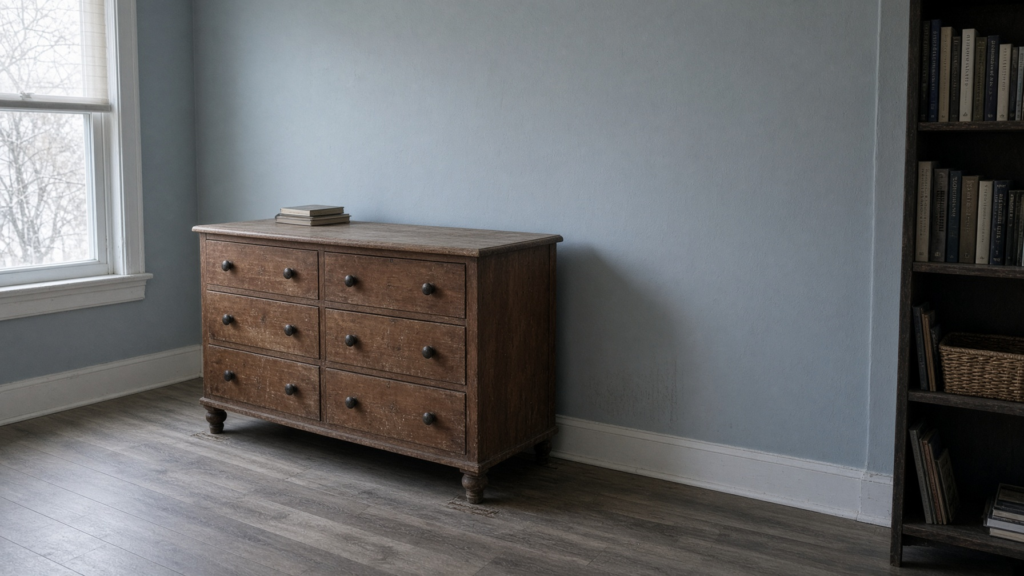
The bottom drawer stuck on a Tuesday. I pulled, and the sweater on top came out smelling faintly like a closed trunk. Not dirty. Not the soap we used. Just old, a little flat, the way fabric gets when it sits too long against something that never warms all the way. I had blamed the wood. The dresser was tall, cheap pine painted over, and it had lived against that wall since we moved the bed in. It was the only place it fit. The bookcase stood right beside it, flush, spines out, a little dusty on the top shelf and fine everywhere else, as far as I could tell.
I put the sweater back. I told myself laundry soap leaves a smell if you use too much. I told myself old furniture holds a smell. Both of those things can be true. They were not the whole story.
The day the legs scraped
We moved it because of an earring. A small gold one, dropped somewhere near the baseboard, and I was already on my knees with a flashlight when it made more sense to slide the whole thing out. The legs scraped. One of them caught the rug and left a pale line. Behind the dresser the wall was a different color than the rest of the room, not because we had painted it, but because nothing had touched it in years. Dust had settled in a soft gray band. Lower, near the baseboard, the paint had a faint freckling. Not a bloom. Not a map. Just small darker marks, cooler to the back of my hand than the wall by the window.
The back panel of the dresser was worse than the wall. Soft in two spots. Spotted, the way cardboard gets when it has been damp and then dry and then damp again. I pressed a finger and the fiber gave. I had been folding clothes against that panel every week.
The bookcase came out next. Its back was cleaner. Less contact, I think, or just luck. The wall behind it was the same cool drywall, the same low freckling, a little less of it where the shelf had stood a half inch proud. I sat on the floor with the flashlight still on and did not know what I was looking at. Dust, I wanted it to be dust. I had already spent a season learning the difference between mold and dust in other corners of the house, and this did not look like the closet. It looked quieter than that.
A pocket where the air did not go
The wall was an outside wall. I knew that. I had not thought about what it meant for a piece of furniture pushed all the way to the paint. In winter the glass on the north side of the house wept in the mornings, a thin line I wiped and forgot, the same way I wrote about the window that always wept once I finally paid attention to it. The dresser had been doing a smaller version of that job in the dark. Warm room air met the cold surface. The moisture had nowhere useful to go. The gap was not a gap. It was a pocket.
No fan reached it. The register was on the other side of the bed. We kept the door open most days, unlike the guest room we kept closed, so I had assumed the bedroom breathed. It did, in the middle. Not behind the tall things.
I thought of the closet down the hall, the one that never really cleared, where hanging clothes made their own still air. This was kin to that, only flatter. A vertical closet we had built by accident out of a dresser and a bookcase and an outside wall. The mold and moisture pages on the site talk about cold surfaces and still air in plain language, and reading them later I recognized the room. At the time I just had a soft panel and a sweater that smelled like a trunk.
What we had been calling the wood
For two winters I had rotated the bottom-drawer clothes to the top and called it freshening. The smell improved for a week. Then it came back, milder, easy to ignore if you were already late. I had wiped the dresser with a damp cloth and felt virtuous. Wiping the face of a piece of furniture does not touch the wall it has been kissing. That is the part I did not want to write down. Cleaning the thing I could see, while the reason sat an inch behind it.
When mold keeps showing up after you have already cleaned, it is often because the water, or the cold meeting the warm, never left. I had learned a version of that the hard way in other rooms, written up later as why mold keeps coming back. The dresser was a smaller lesson. We had not even seen growth we could name. We had seen freckling, a soft back, a smell. Enough.
I did not pull the baseboard. I did not cut the drywall. I am not a person who opens walls for sport, and the page on hidden moisture behind walls is mostly a warning about making a small damp place into a larger one. I looked. I felt the cool. I took the soft panel off the dresser in the garage and let the clothes air on a rack by an open window, which is the unglamorous version of deciding what to do with belongings before you panic and bag the whole room. Some sweaters washed fine. One I did not keep. The bookcase stayed.
How the room sits now
The dresser does not touch the outside wall anymore. There is a hand’s width, sometimes a little more, enough that I can see baseboard if I crouch. The bookcase moved to the interior wall, where the plaster stays closer to the temperature of the room. It looks slightly wrong. The bed is a few inches off its old mark. I notice it every morning and then I stop noticing.
Once a season I pull the tall things out. Not a ritual with a checklist. I am already changing the sheets, or looking for a sock, and the gap is there, so I look. In January the wall behind the dresser is cooler than the wall by the door. That is just winter. It is not freckled. The back panel we replaced is still hard. The bottom drawer still sticks when the house is very dry, which is a wood problem, and I can live with a wood problem.
I still wipe the glass when it weeps. I still leave the closet door cracked more than I used to. The bedroom is not a project. It is a room that had a pocket in it, and the pocket was full of our clothes. If you are new to this kind of noticing, start here is the plain map, and the notes on cleaning and remediation are useful after you have actually seen the wall, not before. I did not need a new theory the day the legs scraped. I needed the flashlight, and the nerve to leave the dresser six inches out from the paint.