
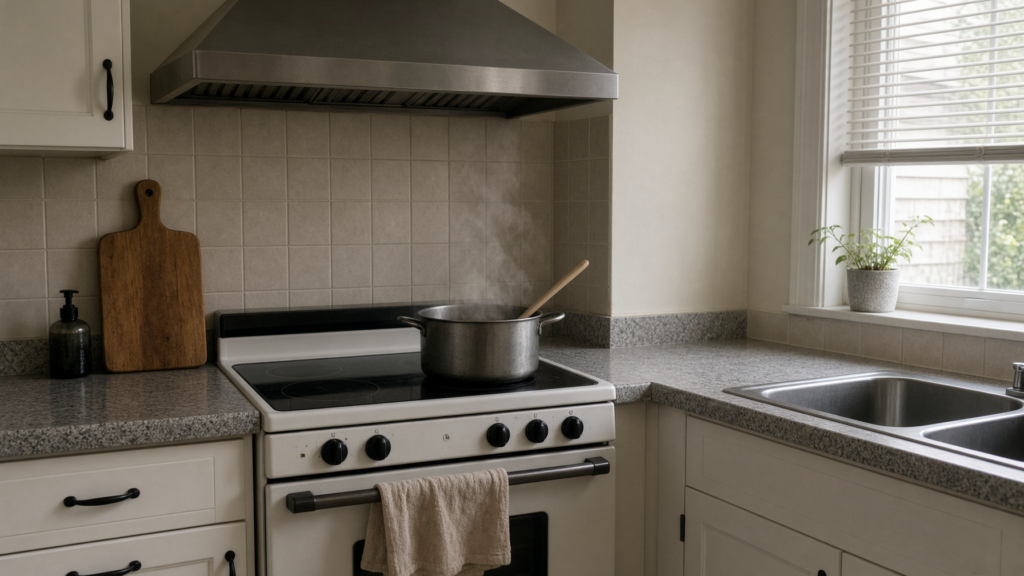
The pot boiled over on a Tuesday. Steam climbed the tile backsplash and hit the underside of the hood, then kept going. I stood there with the burner still on, watching the water run down the front of the stove. The hood above it stayed dark. Its switch was on the wall to the left and I did not reach for it. I reached for the dish towel on the oven handle instead.
That towel stayed damp until the next morning. The kitchen was the warmest room in the house. Heat from the stove, the oven, the dishwasher if we ran it, and none of it had anywhere obvious to go except up and then sideways into the rest of the rooms. The cabinets above the range took on a faint film you could feel with a fingertip. The paint on the ceiling just past the hood edge went soft and slightly yellow at the corners. We said the paint was cheap. We said the cat slept on the counter. We said cooking always smelled.
The smell after frying something sat in the hallway until bedtime. Not strong enough to open a window in January, just present. It mixed with whatever else was already in the house and made the air feel heavier when you walked from the living room to the bedroom. The same heavy feeling showed up when I opened the guest room that we mostly kept shut, the one I wrote about in the guest room we kept closed.
The hood had come with the house. Stainless on the outside, a light that worked if you jiggled the switch, and a metal mesh filter I pulled once in the first year. The filter was dark and sticky. I ran water over it and the water turned gray. I put it back and left it alone after that. The fan never made a sound because we never flipped the switch. The wiring might have been wrong. The switch might have been for the light only. The fan sat there for years while water boiled, oil heated, and oven doors opened and closed.
The day the switch moved
A guest burned a pan. Smoke rose fast enough to trip the alarm in the hallway. I hit the hood switch on the way to the stove because the smoke was right there. The fan came on with a low rattle. Air moved, but not much. The smoke drifted sideways toward the living room before any of it went up. I left the fan running until the rattle made the kitchen feel smaller, then turned it off.
Later that week I took the filter out again. It had caked. The mesh was sealed in places with a layer that looked like the bottom of a used skillet. I soaked it in the sink with dish soap and hot water. The water went dark immediately. Grease floated on the surface. When I scrubbed with a brush the layer broke into soft pieces that stuck to my fingers. I rinsed and soaked it twice more before the water ran clear. Cleaning what had collected on the surface without driving it deeper is the same careful approach I used on other spots, which is why the notes under cleaning and remediation stayed useful even for a range hood filter.
I stood under the hood after that and looked up. The metal inside was clean where the filter had been and dull where it had not. The ceiling paint past the edge of the hood was still yellow at the corners. The cabinet faces above the stove still carried that faint film. The fan had run. Some of what was on the filter had come off. The rest of what we had cooked was already somewhere else.
Where the steam went
I started paying attention to where the air moved when something was on the stove. With the window cracked and the fan on, the steam from a boiling pot went up and mostly stayed near the hood. Without either of those things it climbed the tile, hit the cabinets, and spread across the ceiling toward the doorway. The same thing happened with the oven. When the door opened the heat rolled out and up. If the fan was off it kept going until it cooled against a wall or a window frame. That window over the sink fogged on cold mornings even when no one had cooked, the same way the one I wrote about in the window that always wept kept collecting water on the sill.
What left the pot did not disappear. Some of it landed on the cabinet faces. Some of it stayed in the air long enough to move through the house. Some of it met cooler surfaces farther away and stayed there as moisture. The filter just made the amount of what had been circulating harder to ignore. The closet at the end of the hall held a smell that was not clothes either, the pattern I described in the closet that never cleared.
I looked up the difference between what sits on a surface and what moves past it after the cabinet film came back within a week of normal cooking. Dust and grease sit on top. Moisture that stays long enough can move into the material behind the paint or the cabinet face. Cleaning the surface does not always reach what has already gone past it. Sorting surface film from something that has already moved behind the paint is what I sorted out in how I learned to tell mold from dust.
What I do differently now
I turn the fan on when the burner goes on. The rattle is still there. The airflow is still weak. It moves more air than it did when the switch stayed off. I crack the window over the sink even when it is cold. After I finish cooking I leave the fan on for another ten minutes and wipe the cabinet faces above the stove with a damp cloth while they are still warm. The film comes off easier that way. The longer pattern of moisture that stays in one room and then shows up somewhere else is the same one I keep coming back to on the mold and moisture page.
The ceiling paint has not changed color. I look at the yellow edges when I am waiting for water to boil. They are a reminder of how long the hood sat dark. The towel on the oven handle still gets damp, but it dries by morning if the window is cracked and the fan ran. The hallway does not hold the frying smell the way it used to. Why the same spots come back after you wipe them is the part I had to learn in why mold keeps coming back.
None of this fixed the wiring if the wiring is wrong. The fan still sounds like it is pushing against a clogged path. I have not opened the duct. What changed is that the air from the stove has a route out of the kitchen that is not only the doorway and the walls. Less of it stays on the cabinets and in the rooms we walk through later. I keep the filter in a routine now. Every few weeks it comes out and soaks. The water still turns gray, but less gray than the first time. The mesh stays open. When the fan runs the rattle is quieter.
The kitchen still gets warm. The pot still boils over sometimes. The difference is that the steam has a chance to leave before it settles on everything else in the house. Everything we cooked had been going into the drywall, the cabinet doors, and the air the rest of the house breathed. Some of it still does. Less of it does now, because the switch gets used and the window stays cracked and the filter gets cleaned before it seals itself shut again. The place that ties the rooms together, including this kitchen, is start here.