
I wanted a kit on the counter to be the verdict, and the number that came back still didn’t match the bedroom.
I wanted the box to decide
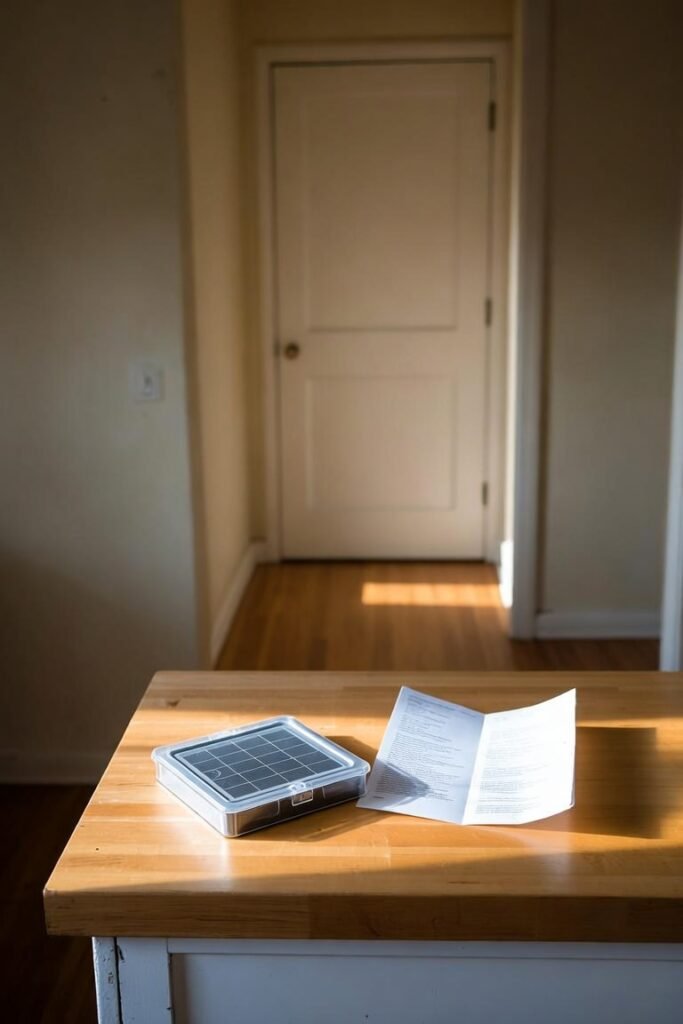
The kit sat on the kitchen counter for two days before I opened it. White cardboard. Plastic cassette. A folded paper that used the word “simple.” I kept walking past it like it might change its mind.
The house still looked fine. That was the problem. Light on the floors. Clean paint. A closed bedroom at the end of the hall that I had started leaving shut because the air in there felt thicker than the rest of the rooms, and I did not have a better sentence for that yet.
I wanted a number. I have a whole testing door now for that hunger. I wanted a page that said yes or no so I could stop arguing with myself in the grocery store and stop nodding when someone said stress. I wanted the test to be the adult in the room.
The bedroom already had an opinion
My child did not look like a lab report. Sleep had gone shallow. Mornings were slower. The cough that never quite became a story I could tell a doctor without sounding like I was reaching. I would stand in the doorway of that closed bedroom and feel my own chest tighten, then walk back to the kitchen and look at the kit again.
There had been a leak months earlier — the kind that belongs on the mold and moisture side of the house, not in a kit. Not a flood. A quiet one. A stain that dried. A smell that came and went depending on the weather and whether the HVAC had been running. I told myself houses do that. New houses do that. Dream houses do that.
I ran the test the way the paper said. Windows shut. Pump humming for a handful of minutes in the middle of a dry afternoon. I mailed it. I waited like the envelope was going to bring me my life back.
A snapshot of the wrong afternoon
The result came back tidy. Counts that did not alarm anyone who liked tidy counts. Outdoor comparison that made the indoor air look ordinary. I stood at the counter with the printout and felt something drop in my stomach that was not relief.
The bedroom still smelled like itself. My child still woke the same way. I still felt clearer in the car than I did after an hour in that hall. The paper and the house were not speaking the same language.
I learned later, in pieces, that an air sample is a moment. Spores move. Doors open. Systems cycle. A dry afternoon is not a wet Tuesday after the AC has been pulling air through a wall that once held water. A cassette does not live in a closed bedroom overnight. It does not watch a child sleep.
The CDC’s line is plainer than most kits: if you can see mold, sampling is often unnecessary. I wrote down what I wish someone had said before I bought the first panel. What no one printed on the box is the other half. If you cannot see it, a single number still may not be the house.
What the number could not hold
I kept the printout in a drawer. I took it out when I needed to feel foolish. I put it back when I needed to feel sane. Both uses were real.
People like a verdict. I liked a verdict. A test that says “within typical indoor range” is easy to carry into a conversation. A closed door and a kid who is not quite themselves are harder to file. I spent weeks trying to make the second thing smaller so it would fit the first.
It did not fit. The stain behind the baseboard later did. The soft spot in the drywall later did. The smell that returned when the seasons changed later did. None of that was in the cassette I ran on a polite afternoon.
I am not saying every kit is a lie. I am saying I asked one afternoon to answer for months of a room.
Some tests helped later. None replaced the house.
There were better samples after that. Timed differently. Taken closer to the wall that had leaked. Paired with moisture readings that did not care what I hoped they would say. Those mattered. They pointed. They did not erase the first report. They sat next to it like two photographs of the same hallway taken in different weather.
I still look at rooms first. I still notice when a bedroom wants the door shut. I still trust the hour after we leave the house more than I trust a page that arrived in the mail. That is not science. That is what happened in this building.
I write this as the woman who bought the kit because she was tired of being told she was anxious. I am not a lab. I am not the person who should design your sampling plan. I am the person who stood in a kitchen that looked finished and learned that a snapshot can be accurate and still miss the room that was making the child look the way the child looked.
The test did not settle it. The house kept talking. I finally started listening to the closed door.
Pingback: Are There Specific Symptoms for Specific Molds? The Truth Behind “Symptom Matching” - IndoorAirInsight.com
Pingback: Mycotoxin Testing: What It Can Tell You, What It Can’t, and What I Wish I’d Known Sooner - IndoorAirInsight.com
Pingback: What Mold Did to My Kids: Behavioral and Developmental Changes To Never Again - IndoorAirInsight.com
Pingback: Is Mold Causing My Anxiety or Depression? The Connection I Didn’t Understand at First - IndoorAirInsight.com
Pingback: Why Mold Makes You Feel Worse at Home (And Better the Moment You Leave) - IndoorAirInsight.com