
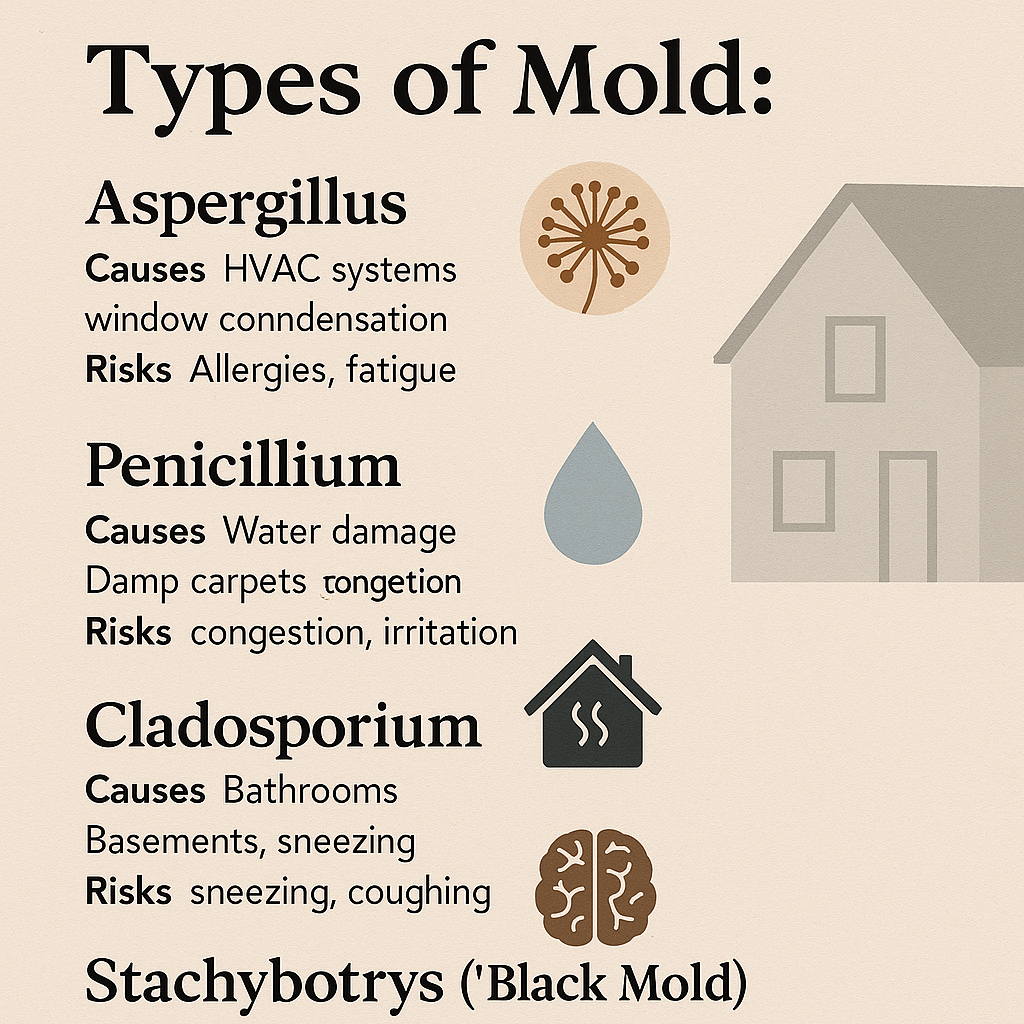
Types of Mold I Found in My Home — Their Effects, Causes, and the Risks
I used to think mold was one animal with one name. Then the closed bedroom at the end of the hall kept its own weather, a windowsill would not wipe like dust, and a wall that looked finished opened onto a stain I had filed under things new houses do. Names arrived later, on paper and on surfaces I could finally see. They did not introduce themselves as a chart. They introduced themselves as places that had stayed wet.
This page is a record of what I actually found in this building — where it sat, what the water was doing, what it looked and smelled like, and what it took to stop feeding it. It is not a legend that assigns a symptom to a Latin word. Bodies belong with a clinician. Walls belong with water.
The first name I treated like a personality
One name showed up in dusty corners and in the path the HVAC had been using. On a grate I had ignored because it photographed as ordinary gray, the film was not the same film as the top of the dresser. Wipe the dresser and it was furniture again. Wipe the grate and a dull speckling stayed in the metal and in the dust that kept resettling after the system ran.
The moisture there was not a flood. It was condensate and stale air and a house that kept circulating whatever it had pulled through a wetter place. Fixing it was not a cloth. It was finding why the system was running damp air and why a room down the hall had a climate the living room did not share. Until that path was interrupted, the grate kept collecting the same gray.
I wanted that name to explain the driveway, the way we felt different when we left. It would not. The grate was a location. The feeling in the car was a different sentence. I keep that second sentence under feeling worse at home and better when we left so I do not hang it on a single organism like a coat.
The one that was waiting behind paint
Another name arrived when the wall finally gave us an honest look. Months after a quiet leak, the drywall in that cavity was no longer only stained. The growth sat on paper facing that had stayed damp long enough to stop being “a mark that dried.” It was not a drama on the living-room side. The living-room side still looked like a choice I had made on purpose.
What it looked like in the opened wall was patchy, and in places almost powdered into the paper. The smell was the same sweet-stale note I had been calling closed-up bedroom air. Water had traveled farther than the first stain suggested. That is the risk I mean when I say risk on this page: a finished surface can hide a wet interior until the interior is a project, not a wipe.
Stopping it meant the water source, then the wet material, then time the cavity did not get the first time I told myself the stain had ended. I write that work under mold and moisture because the organism was a passenger. The leak was the road. I had spent weeks trying to make a species list do the job of a moisture meter I did not want to believe.
The sill I kept calling dirt
The windowsill in the closed bedroom taught me the slowest lesson. Dark bloom along the paint line. A gray that looked like the house needed a better housekeeper. I wiped. Most of it moved. A shadow stayed in the wood, and the carpet edge under that window stayed cooler than the middle of the floor.
That growth lived on a ledge that saw condensation and a frame that never fully dried after weather. It looked like neglect. It smelled, on the wrong days, like cardboard that had been wet. Dust would have left when I asked. This came back in the same stripe. The building risk was small on a photograph and large in a habit: I kept cleaning a sill instead of asking why the sill was a climate.
What it took was less product and more honesty about the window, the room I had started shutting, and the fact that a cloth cannot argue with repeated wet. I had already tried to sort this with a cassette on the kitchen counter. That story is the test that didn’t settle it. The printout did not stand at the glass with a paper towel.
The dark one people say first
There is a name the internet says the way people say a villain. I found dark growth on material that had been wet a long time — cellulose that should have been dry and was not. It did not announce itself in the middle of the floor. It sat where water had been allowed to linger in a wall and in insulation that had no business staying soft.
It looked dense compared with the thinner films elsewhere. The smell in that cavity was heavier than the sill. I will not dress it in a reputation. The risk that mattered in this house was duration. Long wet makes a bigger repair. Long wet means the pretty side of the wall was a delay, not a comfort.
Getting it out of the building meant treating the moisture as the emergency the paint had hidden. Not a headline. A cavity, dry materials, and a refusal to put new paper over a leak I had already underestimated once. If a body is what scared you into this title, that is a clinician’s room. This was a framing room.
What “effects” meant in this house
Effects, here, were effects on the building and on the week we lived inside it. Rooms that wanted the door shut. A smell that changed after rain or after the system ran. Sleep that went shallow in one bedroom. I put the family side of those weeks under health and exposure and under how my kids changed in that house without handing each child to a species. The quieter signs I missed were easy to call stress while the wall still looked fine.
I will not line those changes under four headings with four Latin names. I tried that matching and it was a dead end. Different people in the same hallway did not follow a table. The testing I bought named some of what was present. It did not assign the week. How I write here is on the editorial standards page so I do not turn a grate, a cavity, a sill, and a long-wet wall into a diagnosis wearing my voice.
The CDC treats indoor dampness and mold as a reason to deal with the building. That is the only public-health sentence I need next to these names. Water first. Names second. Bodies with someone qualified to look at bodies.
The risk I actually lived
The risk was not that I failed to memorize a chart. The risk was a house that could look finished while a sill, a grate, and a cavity kept a climate. Every type I found was a sign the materials had been given water and time. That is a building problem with a building cost. It is also a reason not to wait for a more impressive color.
I still walk ledges before I walk lists. I still trust a cool baseboard more than a reputation. If you need the rest of this site after the names, Start Here is the map. Leave the villain speech. The leak, the window, and the wall that opened were the sentences that held.
Pingback: Can Mold Cause Paranoia, Delusional Thinking, or Feeling “Not Like Yourself”? What I Wish I’d Understood Sooner - IndoorAirInsight.com